Sunday, 14 October 2012

CARLY RAE JEPSEN 'CALL ME MAYBE' MUSIC VIDEO ANALYSIS


For this music video we looked mainly at camera and lighting techniques. We are introduced to the artist as the camera moves in towards her where it is followed by an extreme close up and then later a medium close up of the artist. This creates a star image and so the audience are introduced to her and are able to recognise her. Tracking shots have been used to track from side to side. This means that there is constant camera movement throughout the music video, especially within the performance scenes. High key lighting has been achieved through the use of three point lighting which creates a ‘glamorous’ appearance. Lots of fill lighting has also been added so that the artist is highlighted and so this creates a star image.


The camera movement makes the music video flow better and makes it more interesting as opposed to still shots. It also makes the lens flares move across the screen. During the performance scene s the shots vary from a medium close up to a close up to a long shot. The changes in shots are made more interesting through fast paced editing. This matches the energy and speed of the music and so this creates a relationship between the visuals and music. Backlighting is also used within the performance, this means that the lighting is diegetic; it is also blurred, which adds depth to the shot.
 
 
Backlighting also adds lens flares to the shots as well as a halo around the artist and so this adds contrast to the shot as well as making her appear ‘glamorous’. The camera and lighting techniques used within the music video are effective and create a star image for the artist as well as making it visually exciting for the audience. This has helped me learnt the importance of camera movement and how it can be used to make a music video appear professional and more interesting.


PARAMORE 'IGNORANCE' MUSIC VIDEO ANALYSIS


Paramore ‘Ignorance’ is a performance based music video of the rock genre and so displays different codes and conventions used in Carly Rae Jepsen’s music video for ‘Call Me Maybe’. However, like the ‘Call Me Maybe’ the music video for ‘Ignorance’ uses lots of camera movement and so the camera is constantly moving and so this adds to the quick pace of edit and gives an energetic and jumpy performance which is often seen within rock genre music videos. The strobe lighting is quite fast and so this also adds to the fast pace and makes it more interesting for the audience to watch.
 
The lighting however is not a conventional lighting set up and is mostly diegetic. During the music video the female vocalist holds a light on a cord, this allows her to move the light around and so this casts shadows over the band member’s faces as well as her own. This creates low key lighting as there is lots of contrast as well as shadows and so dynamic elements have been created as well as adding depth to create a three-dimensional effect. She also shines the light into the camera and so this creates lens flares as well as having it conceal parts of her face, which creates a mysterious and dark atmosphere.

By singing into the light it lights up her face and so this creates a star image, this is important because the vocalists of a band are normally pushed more into the spotlight because they are the front man or woman for the band and so making them stand out will allow the audience to instantly recognise the band. A fill light from a window has been used to add extra lighting as well as making the shot more three-dimensional. Backlighting is typical of the rock genre as it adds depth to the shot as well as creating lens flares and the halo effect. Here it has been used to create lens flares that create depth as well as being used to make the mist in the background appear more prominent and so this gives the audience something else to focus on.
 
 
There is also a halo around the vocalist’s head and so this makes her appear more important. The use of lighting and camera movement fits the genre well and helps to give a dark atmosphere to the music video which is indicative of the rock genre.  


Saturday, 13 October 2012

LIGHTING SET UP EXPERIMENTATION


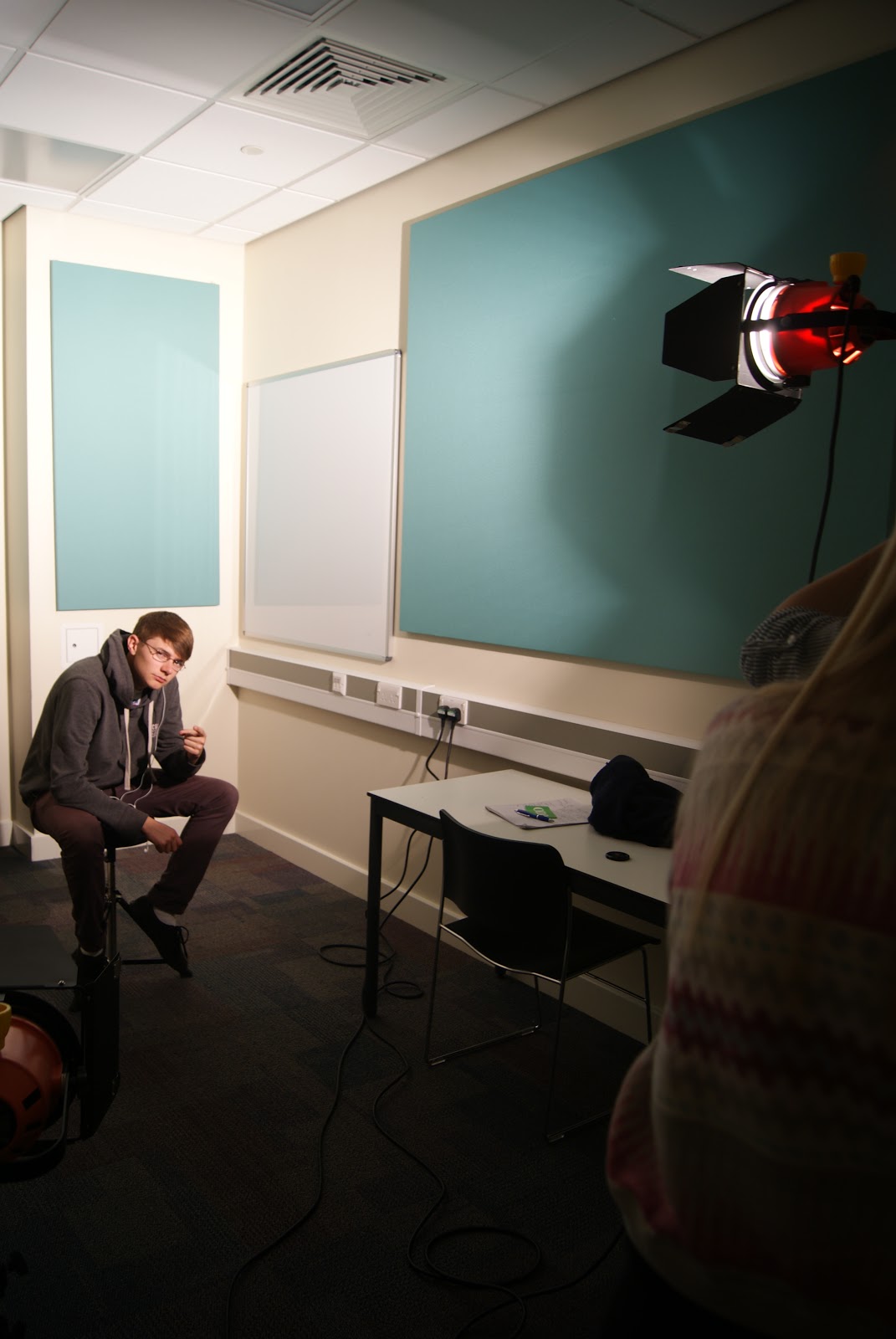
As we had decided that we wanted a performance and narrative based music video we thought that it would be a good idea to experiment with different lighting to see what kind of effects we could achieve. For this experiment we only had two studio lights to work with. However, we were able to look at lighting direction and positioning as well as looking at what effect the lighting would give in one of our chosen locations.


Here, we really liked how the lighting cast two shadows behind the subject as we thought that it added more detail and depth to the shot which makes it more interesting.


In this shot the subject and location appear over-exposed and so we soon realised that we didn't need all of the three point lighting and also the room lighting to be all on to achieve a ‘natural’ room setting.


We also experiment with the height of the lighting to see if it affected the way the room and subject was lit. We found that it altered the directions of the shadows and this shot appears quite similar in the respect of lighting as some of the other shots.


We also wanted to experiment with backlighting to see if we could achieve the right effect using a lens flare. In some of the shots we found that there was a slight silhouetted effect as some of the facial detail was lost due to the contrast through the backlighting. By using the barn doors we directed the light and so we could control the direction of the lens flares as well as moving the camera to different angles. This meant that we were finally able to achieve that included backlighting that gave a lens flare as well as a halo effect while not losing the detail in the subject’s face.

We found this to be beneficial as we were able to test various lighting arrangements and techniques that we considered using within our music video. It also meant that we could see what the lighting on a subject could look like at different distances away and if the facial details were lost in the movement of the camera.

MUSIC VIDEO IDEAS AND NOTES


TYPE OF MUSIC VIDEO

   Performance
   Narrative - Fragmented

CHARACTERS

   Shqipdon – Artist – Central protagonist – Ella’s boyfriend
   Ella – Shqipdon’s girlfriend
   Liam – The man Ella is cheating on Shqipdon with

PLOT

   Shqipdon and Ella have just gone through a break up and Shqipdon is still in love with her and Ella is seeing another man and Shqipdon sees them together.
   Shqipdon and Ella are going out and as Shqipdon arrives at Ella’s house he find out that she is cheating on him with another man but they don’t see him.

LOCATIONS

   Performance studio – College
   Music practice room
   Park
   Town
   Josh’s house
 
CAMERA TECHNIQUES

   Close up – Star image – Photographs
   Extreme close up
   Tracking shot
   Long shot

LIGHTING

   Three point lighting
   Reflectors
   Soft lighting
   Low key lighting
   High key lighting

EDITING

   Slow movement
   Slow pace of edit
   Desaturation
   White flashes
   Rhythmic cutting
   White balance

We found that noting down our ideas to be helpful as we could look over our notes and add to and develop our ideas. We also thought that it would help us in planning our storyboard and production schedule so that we didn't forget anything.

LIGHTING SET UP TUTORIAL


Watching a video on lighting set up really helped us in coming up with ideas on how to light our own music video, especially in the performance scenes. High key lighting provides a ‘flawless’ and ‘glamorous’ appearance as the face is highlighted and there aren’t many shadows and a low amount of contrast. Soft lighting can also be used to give this effect as well as lighting a scene to give a ‘natural’ effect as opposed to using harsh lighting. Natural lighting is not commonly used and is not always completely natural as reflectors are used to reflect the light onto the intended subject and so they appear highlighted and so this helps to create a star image.

Three point lighting is commonly used in music videos, especially in a performance sequence. Key lighting is used to highlight the subject, this helps to create a star image. The fill light gives the subject and scene a more three-dimensional effect and so it doesn’t look flat. The back light creates a contrast and so you get more shadows with by using this light. The back light is also often diegetic as it is mostly used in shot, it can also be used to create lens flares and adds depth to the shots as well as making the shots appears more interesting blurring the background and having the subject in focus creates a shallow or deep depth of focus, depending on the camera angle.
 
Using colour correction enables you to have a darkened background and so the subject appears more dominant within the frame and so this adds to the star image. Having a shot of lights or even having the lights slightly in the shot and out of focus adds depth to the shot and makes the shot more interesting. I found this tutorial to be helpful for our music video as it would help us to light our scenes in both conventional and interesting ways which will hopefully make our music videos more professional.

CODES AND CONVENTIONS OF MUSIC VIDEOS SPIDER DIAGRAM


Creating a spider diagram for the codes and conventions has helped me because I have been able to look at the different codes and conventions and come up with different ideas that would fit in with our music video. it has also made me realise that different genres contain different codes and conventions and how they sometimes even help an audience to get an understanding of the genre through codes and conventions without even realising it.

BEN L'ONCLE SOUL 'SEVEN NATION ARMY' MUSIC VIDEO ANALYSIS


‘Seven Nation Army’ performed by Ben L’oncle Soul is a cover of the original song by The White Stripe. This music video is both performance and concept based. It uses stop motion animation within the music video which makes it more engaging for the audience as well as making it appear slightly abstract. Rhythmic cutting has been used so that the shots cut to the beat of the snare drum. This has been created through a series of jump cuts. It makes the visuals match the speed of the music. Even though stop motion animation has been used, real footage also makes up a majority of the music video and so a star image can still be constructed. It also shows him interacting with his surroundings which make a link between the real footage and the stop motion animation.
 
 
Vivid colours such as the orange give the music video quite a dated feel as people don’t tend to use launderettes now a day and so is a thing of the past. Soft lighting also adds to the vivid colours because the scene is well lit and so there is not many shadows or contrast. The music video also includes a voyeuristic element through the use of a high angle, which makes the woman appear vulnerable. We are also made to focus on her legs as the rest of her body is covered by a newspaper. Leading lines also makes us focus on her legs as the lines guide our eyes towards her. This creates sexualisation which could be an intertextual reference to an advert made for Levi’s underwear for men as she appears sexualised and the location is in a laundrette which is where the advert takes place.
 
 
The instruments in particular, he trumpet provides iconography in which the audience are given a suggestion to the genre of the song. The name of the washing powder is called ‘Soul Wash’ which is a reference to the name of the artist, ‘Ben L’onlce Soul’. It also emphasises the artist and creates a star image. The background consists of striped triangles and creates an intertextual reference and so it appears that he is paying homage to the band because the music video is a cover for the song. This music video is successful because it creates an upbeat and energetic atmosphere that matches the tempo and feeling to the song.